




FTA Ecosystem: From strategic infrastructure to a breakthrough drive for the Vietnamese economy in the new era
Wednesday, 16/09/2026

Over the past two decades, Vietnam has affirmed its position as an remarkably open economy. Participating in the implementation of 17 active Free Trade Agreements (FTAs), particularly new-generation FTAs such as the CPTPP, EVFTA, and UKVFTA, has opened broad doors for international trade. Thanks to deep tariff reduction commitments and a strong trade liberalization roadmap, Vietnam's import-export turnover has continuously broken records year after year, making significant contributions to GDP growth and driving the national economic restructuring process. However, looking directly at implementation realities, the utilization of preferences from these agreements remains disproportionate to their inherent potential. Vietnamese enterprises, especially small and medium-sized enterprises (SMEs), face countless barriers. These include a lack of in-depth market information, difficulties in understanding and meeting complex Rules of Origin, and limited capacity to comply with Technical Barriers to Trade (TBT) and Sanitary and Phytosanitary (SPS) measures. Alongside these is the loose, uncoordinated connection between links in the domestic value chain.
To clearly identify these barriers, one can deeply analyze four systemic bottlenecks currently surrounding the business community:
First is the barrier regarding information and the capacity to decipher legal commitments. Although FTAs offer many preferences, legal commitment documents are often thousands of pages long with complex specialized terminology. Most SMEs lack dedicated R&D or legal advisory departments, leading to an "information blindness" or an inaccurate understanding of HS codes, tariff reduction roadmaps, or accompanying non-tariff conditions. Enterprises know preferences exist but are unclear whether their products qualify, or what procedures are required to prove it.
Second is the problem of Rules of Origin (RoO). This is considered the "key" but also the "most tightly closed door" for Vietnamese goods. New-generation FTAs require strict intra-bloc value ratios or closed-loop production processes (such as the "yarn forward" rule in textiles or wholly obtained rules for agricultural products). Meanwhile, Vietnam's key export manufacturing sectors still rely heavily on imported raw materials from non-FTA countries. This lack of proactivity in input raw materials means many shipments, despite being produced in Vietnam, fail to meet preferential C/O standards and must accept standard tariff rates.
Third is the barrier of Technical Barriers to Trade (TBT) and Sanitary and Phytosanitary (SPS) measures. As tariffs reach 0%, major import markets such as the EU, Japan, the United States, and the UK increasingly erect non-tariff barriers. Regulations on greenhouse gas accounting, traceability, labor standards, environmental protection, and allowable chemical residues are growing ever stricter. Many Vietnamese enterprises, limited by technology, capital, and quality management capacity, easily get caught in warning notices or even face returned goods, causing severe financial damage and brand reputation loss.
Fourth is isolation within value chains and escalating logistics costs. Vietnamese enterprises mainly operate in the original equipment manufacturing (OEM) segment with low added value, possessing little horizontal integration among industry peers or vertical integration with domestic suppliers. The absence of industry clusters leaves supply chains fragmented. Alongside this, logistics costs in Vietnam currently account for an excessively high proportion of product costs (14% to 20% of GDP), significantly higher than the global average. This situation erodes the price competitiveness of Vietnamese products when stepping onto the international stage.
To thoroughly resolve these systemic bottlenecks, shifting from isolated support measures to building and operating a synchronized, multi-stakeholder FTA Ecosystem has become a strategic step, creating momentum to help the economy shift from quantitative growth to quality and sustainability. On June 26, 2026, the Government issued Decree No.240/2026/ND-CP, in which elaborates and provides measures for the implementation of certain provisions on mechanisms and policies for mobilizing resources to build and operate the FTA Ecosystem.
In essence, the FTA Ecosystem is a multi-dimensional interactive network between state management agencies, the business community, advisory organizations, logistics providers, banks, and research institutes. The core structure of this ecosystem is firmly supported by five main pillars:
(i) Data infrastructure and digital technology: A shared data-sharing platform covering tariff schedules, rules of origin, trade flow movements, and early warning systems for technical barriers. The integration of AI and Big Data technology on this platform allows for the automation of HS code lookup processes, rapid calculation of Regional Value Content (RVC), and real-time updates of trade policy changes from partner markets.
(ii) Specialized support service network: A aggregation of legal advisory bodies, quality certification agencies, Certificate of Origin (C/O) issuance authorities, and customs brokerage agents. This pillar acts as a specialized bridge, helping standardize documentation, shorten clearance times, and inspect goods to meet international standards right within the domestic market.
(iii) Supply chain and logistics integration: A mechanism connecting domestic raw material suppliers with export manufacturers to increase the domestic value content (RVC). This pillar focuses on forming industrial clusters and integrating smart, green logistics networks, optimizing transport and warehousing costs.
(iv) Finance and trade credit: The participation of commercial banks providing trade finance packages, green credit, and export risk insurance. By making transaction data transparent within the ecosystem, enterprises can easily access preferential credit at lower costs without relying entirely on traditional collateral.
(v) Incident resolution support: A network to receive, advise on, and promptly handle legal bottlenecks, trade disputes, trade defense lawsuits, as well as unexpected incidents encountered by enterprises during FTA implementation and utilization. This pillar creates a shield protecting the legitimate rights of enterprises against overseas anti-dumping and anti-subsidy investigations.
The smooth operation of these five pillars relies on the principles of data sharing and transaction cost reduction, helping enterprises access support resources in the most proactive and precise manner.
When brought into practical operation, the ecosystem brings immense value-added to the macroeconomy across multiple dimensions. First and foremost, it helps optimize the preferential tariff utilization rate. In the context where the current preferential C/O utilization rate reaches only about 33% - 40%, automating lookup processes and compliance guidance will significantly raise the proportion of exported goods enjoying 0% tariff rates, directly increasing net export turnover and trade surplus.
Besides, the ecosystem enhances the autonomy of the national supply chain by creating domestic material supply-demand connection channels, solving the weakness of reliance on imported raw materials from outside the bloc, and fostering the development of supporting industries. This connection helps domestic manufacturing sectors increase the value content created in Vietnam, thereby meeting strict origin standards without supply chain disruptions during global market fluctuations.
Not stopping there, the ecosystem also serves as a bridge driving digital transformation and green transition, guiding enterprises to implement standards on green production and carbon emission reduction (such as the EU's CBAM mechanism or EUDR anti-deforestation regulations), helping Vietnamese goods maintain long-term competitive advantages. Enterprises are not only provided with information but are also advised on technical solutions, greenhouse gas inventory roadmaps, and access to green credit sources to convert production technologies in line with sustainable trends.
For the business community and managers, the impact of the ecosystem is direct and practical. On the part of import-export enterprises, they can minimize compliance costs through a digital single-window mechanism, proactively manage risks thanks to early warning systems against trade defense investigations or changes in technical standards, and easily access preferential credit from banks due to data transparency. The addition of the incident resolution support pillar also helps enterprises build legal response capacity, rapidly resolving customs bottlenecks or disputes arising in foreign markets.
From a management perspective, functional agencies will enhance governance efficacy through a comprehensive view based on real-time data, thereby formulating accurate policies and optimizing trade promotion resources without duplication. Accurate data capture helps ministries and sectors precisely forecast trade trends, promptly propose macro intervention solutions, and negotiate supplementary clauses in FTAs in the most effective manner.
To effectively implement the FTA Ecosystem in practice, it is necessary to clearly define an execution roadmap based on a tripartite coordination model:
(i) The State (Regulatory Agencies): Plays the enabling role, building the legal framework, issuing open data standards, and initiating the construction of shared technology infrastructure. The State acts as the coordinator, interconnecting data between Customs, Tax agencies, the Ministry of Industry and Trade, provinces and cities, C/O issuing authorities, etc.
(ii) Enterprises (Operational Center): Play the role of key beneficiaries and main operators. Enterprises need to proactively standardize production processes, maintain information transparency, actively contribute data, and apply digital tools to optimize import-export operations.
(iii) Service and Financial Organizations (Support Force): Banks, logistics corporations, legal consulting firms, testing laboratories, and industry associations provide high-quality commercialized products and services, helping complete value chains and enhance synergy for the ecosystem.
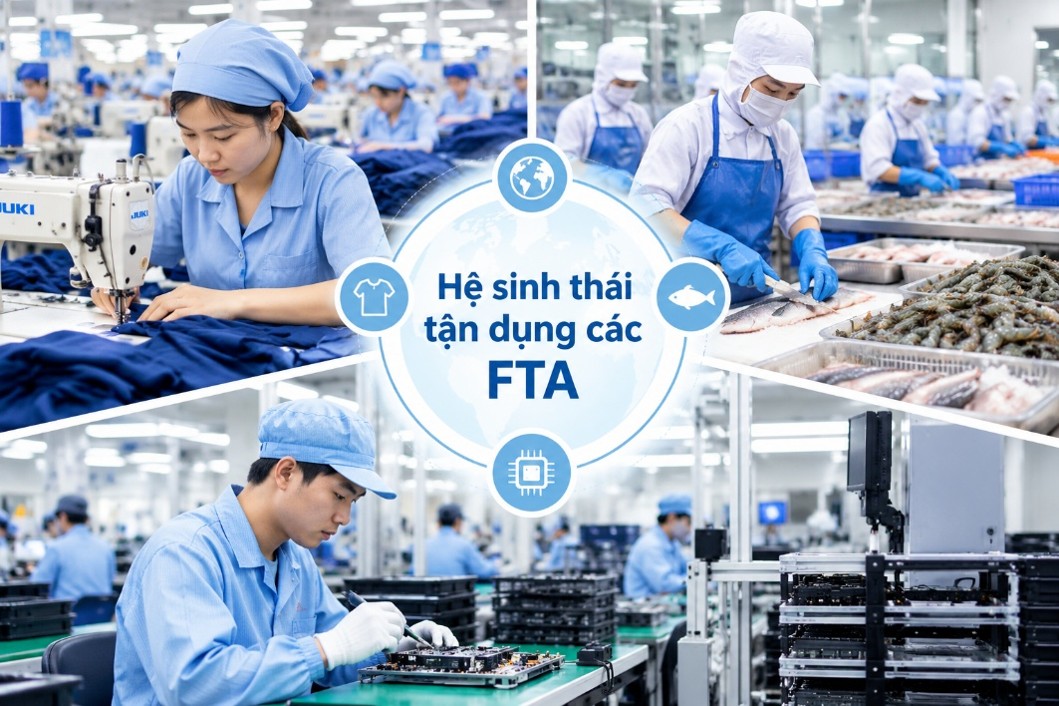
The implementation roadmap is executed in three phases, beginning with a pilot phase focused on building basic digital data infrastructure and testing operations on one to two key export sectors with high volume, such as textiles or seafood. Once pilot models stabilize, the process transitions to an expansion phase to fully complete all five pillars while deeply connecting with banking and logistics systems to scale across all core export sectors. Finally, the standardization and autonomy phase aims to automate the entire process and transfer certain service segments to private sector operation under the Public-Private Partnership (PPP) model, thereby ensuring sustainability and flexible adaptability of the ecosystem against global trade fluctuations.
In summary, the FTA Ecosystem is not merely a trade support tool, but strategic infrastructure for enhancing national competitiveness. Benefits from the ecosystem can only be maximized through active, synchronized participation from all three blocks: the State as enabler and coordinator; enterprises as operational center; and service-financial organizations as support force. Successful deployment of this ecosystem will form a solid foundation for Vietnam's economy to take off in the upcoming period of deep integration.
| The FTA Ecosystem is designed to establish a comprehensive network connecting stakeholders across the value chain – from production, processing, logistics and finance to business associations and government authorities – thereby enhancing their ability to access, implement and effectively leverage FTA commitments. The Ecosystem aims to shift the focus from merely providing information to supporting businesses in “knowing, understanding and applying” FTAs, strengthening competitiveness, promoting higher-value exports, fostering sustainable development, and enabling deeper participation in global value chains. The Scheme on the FTA Ecosystem for the 2026–2030 period, with a vision to 2035 was approved under Decision No. 1253/QD-TTg dated 10 July 2026 of the Prime Minister. The mechanisms, policies and criteria for implementing the FTA Ecosystem are provided for and guided under Government Decree No. 240/2026/ND-CP dated 26 June 2026. |
Source: Department for International Market Development and Multilateral Trade