




Leveraging the strengths of key export sectors with the support of the FTA Ecosystem
Monday, 21/09/2026
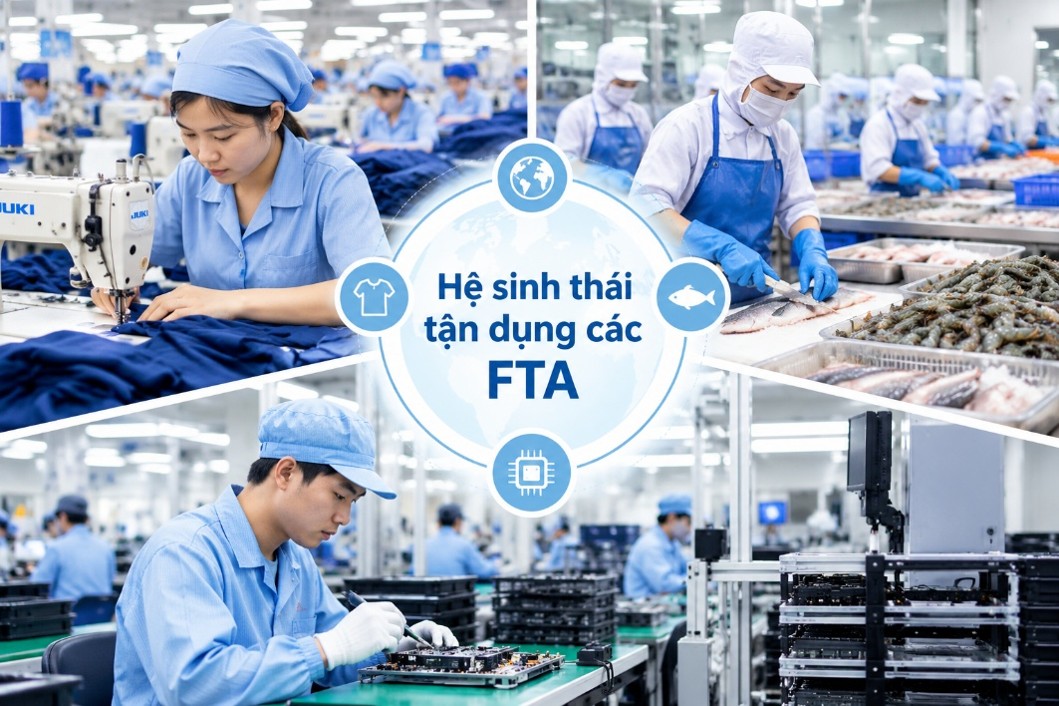
Viet Nam has established and reinforced a solid position on the global trade map with key export sectors, including textiles, garments, footwear, agriculture, forestry, aquaculture, wood and wooden products, as well as electronics and supporting industries. The process of deep international economic integration—especially through the signing, implementation, and effective execution of 17 active Free Trade Agreements (FTAs) alongside numerous bilateral and multilateral cooperation mechanisms—has opened unprecedented tariff preference doors for Vietnamese goods entering major markets. However, as tariff barriers are gradually removed according to the commitments of new-generation FTAs, the greatest challenge for key export sectors has rapidly shifted toward increasingly sophisticated, stringent, and multi-dimensional non-tariff barriers. Strict regulations on rules of origin, food safety standards, sanitary and phytosanitary (SPS) measures, technical barriers to trade (TBT), along with emerging requirements regarding sustainable development, green transition, greenhouse gas reduction, and social-labor responsibilities, are becoming complex hurdles that demand proactive adaptation from enterprises. In this context, the application, operation, and widespread adoption of the FTA Ecosystem tailored to each specific sector serve as the strategic key to unlocking new growth spaces. This helps transform "on-paper" preferences into practical competitive advantages, enhancing value added and solidifying the global standing of Vietnamese products.
For the textile – garment and footwear sectors, two key economic pillars that employ a massive workforce and contribute tens of billions in export turnover annually, rules of origin remain the primary bottleneck in optimizing benefits from new-generation FTAs. High-standard trade agreements such as the Comprehensive and Progressive Agreement for Trans-Pacific Partnership (CPTPP), the EU-Viet Nam Free Trade Agreement (EVFTA), and the UK-Viet Nam Free Trade Agreement (UKVFTA) impose strict origin criteria, notably the "yarn forward" rule in CPTPP or "fabric forward" rule in EVFTA and UKVFTA. Meanwhile, domestic supply chain capacity still exhibits notable gaps, particularly in weaving, dyeing, finishing, and high-end accessory manufacturing, leaving many Vietnamese garment enterprises dependent on imports from non-FTA countries. The inception and operation of the FTA Ecosystem directly resolve this classic problem through a comprehensive digitized database that multi-dimensionally connects yarn, weaving, dyeing, and accessory manufacturers with finished product makers domestically and across the entire intra-FTA region. Thanks to this smart connectivity infrastructure, textile, garment, and footwear businesses can easily look up, cross-check, and match trade with supply partners that meet regional cumulation criteria. They can also utilize automated calculation tools for Regional Value Content (RVC) or non-originating material allowances (De Minimis) to choose the optimal origin proof strategy for each export shipment. Furthermore, the ecosystem integrates support tools for labor standard compliance, chemical management, and environmental monitoring (such as REACH standards and carbon footprint tracking), empowering Viet Nam's textile and footwear industries not only to meet pure origin criteria but also to confidently transition toward a "green fashion" model that satisfies strict ecological standards in the EU and other developed markets.
In the agricultural, forestry, and aquatic sectors, Viet Nam's superior natural comparative advantages and continually improving production and processing capacities frequently face complex technical barriers regarding food safety, phytosanitary inspection, pesticide and antibiotic residue limits, and strict traceability requirements from premium markets such as the EU, the United States, Japan, and the United Kingdom. Additionally, new global trade adjustment policies—such as the EU Deforestation Regulation (EUDR) and strict enforcement against Illegal, Unreported, and Unregulated (IUU) fishing—are applying direct survival pressure to the entire Vietnamese agricultural value chain. The FTA Ecosystem acts as a multi-dimensional digital data connection infrastructure, integrating information from planting area codes, farming zone codes, packaging facilities, and processing plants to export certification systems and regulatory monitoring data. This end-to-end transparency and digitization from farm to table enable Vietnamese agro-aquatic products to prove legal origin, ensure accountability, and pass customs inspections as well as technical barrier post-checks seamlessly. Concurrently, early warning systems embedded deep within the ecosystem continuously update and analyze changes in Maximum Residue Limits (MRLs), labeling/packaging rules, and environmental standards from import markets. This helps farmers, cooperatives, and processors proactively adapt farming, harvesting, preservation, and preliminary processing practices in a timely manner, minimizing the risks of alerts, rejections, or export bans.
For the electronics, mechanical, and supporting industries, which account for a major share of total export value and act as key drivers of industrial growth in Viet Nam - the actual retained domestic value remains relatively limited due to production remaining largely concentrated in lower-tier processing and assembly. The greatest barriers for this sector are below-expectation localization rates, modest technological and management capacities of domestic manufacturers, and high cost/technical obstacles in achieving international quality management and technical certifications for supporting components. Through the FTA Ecosystem, Vietnamese supporting industry enterprises can leverage multilateral origin cumulation mechanisms to expand supply chain connectivity for components and parts with partners across CPTPP, RCEP, or EVFTA spaces. The ecosystem forms a strategic bridge that links Foreign Direct Investment (FDI) enterprises with domestic manufacturers, driving technology transfer, technical advisory, and assistance for Vietnamese firms to achieve international quality standards (such as ISO, IATF). This establishes a solid foundation to increase domestic supply rates, reduce reliance on non-FTA raw material imports, and enable Vietnamese mechanical and electronic products to progressively enhance their technological content, integrate deeper, and secure higher positions in global value chains.
In general, to convert theoretical opportunities under FTAs into actual export turnover and tangible value added for the economy, standardizing production data, improving compliance capacities with international regulations, and fully integrating digital tools into operations constitute a mandatory roadmap for every key export sector. The FTA Ecosystem goes beyond being a basic information portal or lookup tool; it functions as a strategic coordinating platform that integrates overall resources among government management agencies, industry associations, manufacturing enterprises, and service providers in logistics, finance, and legal consulting. The proactive adaptation, mindset innovation, and sustained competitiveness of the business community—combined with synchronized coordination and support tools from the FTA Ecosystem will serve as a firm foundation helping Vietnamese-branded products consolidate their current standing, expand market share in strategic regions, and achieve sustainable, breakthrough growth on the international stage.
| The FTA Ecosystem is designed to establish a comprehensive network connecting stakeholders across the value chain – from production, processing, logistics and finance to business associations and government authorities – thereby enhancing their ability to access, implement and effectively leverage FTA commitments. The Ecosystem aims to shift the focus from merely providing information to supporting businesses in “knowing, understanding and applying” FTAs, strengthening competitiveness, promoting higher-value exports, fostering sustainable development, and enabling deeper participation in global value chains. The Scheme on the FTA Ecosystem for the 2026–2030 period, with a vision to 2035 was approved under Decision No. 1253/QD-TTg dated 10 July 2026 of the Prime Minister. The mechanisms, policies and criteria for implementing the FTA Ecosystem are provided for and guided under Government Decree No. 240/2026/ND-CP dated 26 June 2026. |
Source: Department for International Market Development and Multilateral Trade