




FTA Ecosystem: A strategic infrastructure solution to promote digital transformation and export supply chain finance
Thursday, 24/09/2026
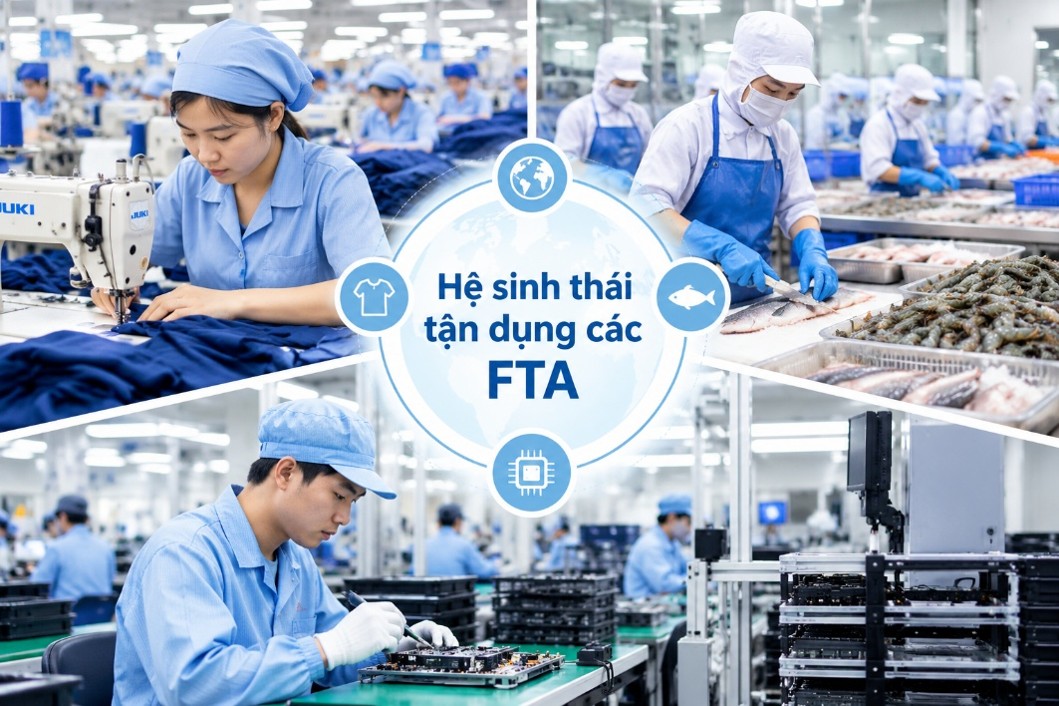
Viet Nam has firmly established its position as an open economy in the region and the world by building an extensive network of free trade relationships. The presence of Free Trade Agreements (FTAs) has opened wide doors for Vietnamese goods to reach high-end consumer markets. Key export sectors,such as textiles and garments, footwear, agriculture and fisheries, electronics, and precision engineering,have continuously achieved breakthroughs in turnover, serving as pivotal pillars of the national economy.
However, practical integration shows that as tariff barriers are gradually removed according to commitment roadmaps, challenges for export sectors do not decrease but transform into a more complex form: non-tariff barriers. Stringent rules of origin, food safety standards, sanitary and phytosanitary measures, trade remedy actions, along with a series of new labor and environmental standards, have become daunting hurdles for the business community. Single-handed support or ad-hoc problem solving is no longer suitable. In this context, developing and operating a comprehensive FTA Ecosystem providing solutions to promote digital transformation and facilitating access to credit and financial resources,, creating a synchronized connecting infrastructure that translates policy advantages into tangible competitive capacity for each sector and individual enterprise.
For the textile, garment, and footwear industries,two sectors employing a massive workforce and contributing tens of billions of USD in annual export turnover,the value added retained domestically remains disproportionate due to bottlenecks in input raw materials. The FTA Ecosystem directly addresses this bottleneck by establishing a digitalized data platform that integrates the supply chain, consolidating information from domestic yarn, weaving, dyeing, and accessory manufacturers, as well as those across member countries within the same agreement. When orders arise, enterprises can proactively connect with qualified suppliers within the trade block to satisfy cumulation criteria, while utilizing automated tools to calculate Regional Value Content (RVC) and Change in Tariff Classification (CTC) to determine the most optimal origin documentation approach.
For the agricultural, forestry, and fishery sectors, which possess Viet Nam's natural comparative advantages, vulnerability to technical barriers and sanitary and phytosanitary (SPS) measures remains high. Major import markets continuously tighten maximum residue limits for chemicals, pesticides, and antibiotics, while imposing strict requirements on traceability and Illegal, Unreported, and Unregulated (IUU) fishing combat. The FTA Ecosystem acts as a seamless data infrastructure connecting state management agencies with export processing enterprises. Data regarding planting area codes, farming zone codes, packaging facility credentials, and quarantine certificates are synchronized on a single platform. Upon dispatch, the entire production log and quality documentation are embedded into a digital traceability code, facilitating smooth customs clearance in importing countries. Furthermore, the ecosystem's early warning feature updates technical regulation changes from target markets in real time, enabling farmers and enterprises to adjust cultivation, harvesting, and processing procedures promptly to avoid cargo warnings or rejections.
Beyond sector-level guidance, the ecosystem delves into digitalizing and standardizing the daily operational workflows of individual enterprises. When exporting to a market where multiple FTAs are simultaneously in effect, businesses are supported with automated lookup and comparison tools covering tariff reduction roadmaps and corresponding origin rule complexities to select the optimal path. Calculations for RVC percentages or evaluations of De Minimis thresholds are fully automated, eliminating human errors. By establishing online data linkages between an enterprise's internal management system and authorized Certificate of Origin (C/O) issuing bodies, C/O application procedures are automatically cross-checked, reducing processing times to just a few hours. For the self-certification of origin mechanisms featured in FTAs, the ecosystem functions as a secure repository, enabling businesses to manage and present legally compliant origin evidence proactively during customs post-clearance audits.
Concurrently, the ecosystem partners with enterprises in fulfilling commitments to sustainable development and modern green standards. Contemporary FTAs have elevated environmental and labor commitments into mandatory obligations directly tied to trade preferences. Adding to this are newly enacted policies from developed markets, such as the Carbon Border Adjustment Mechanism (CBAM), the European Union Deforestation Regulation (EUDR), and the Corporate Sustainability Due Diligence Directive (CSDDD). To assist small and medium-sized enterprises lacking specialized technical resources, the ecosystem provides integrated self-assessment tools, greenhouse gas inventory guidance templates, and sector-specific green manufacturing standards. Digitalizing this entire pathway helps enterprises reduce independent consulting expenses. Additionally, the ecosystem links geographical positioning (GPS) data of raw material sourcing areas and Sustainable Forest Management (FSC) certifications directly to export documentation, creating total transparency that helps Vietnamese goods smoothly pass sustainability audits conducted by international partners.
With regards to credit support, another critical breakthrough is the integration between the ecosystem and financial institutions to solve working capital challenges and deliver comprehensive risk management. Because comprehensive data on orders, C/O compliance histories, and sustainability standard adherence are transparently stored, commercial banks gain reliable reference points to conduct automated loan appraisals. Consequently, banks can apply cash-flow collateralized loans, Supply Chain Finance, or green credit packages with preferential interest rates for clean manufacturing projects without requiring excessive traditional physical collateral. Moreover, the ecosystem's early warning system continually analyzes abnormal trade volume fluctuations to forecast potential trade remedy lawsuits. Should issues arise at overseas ports, enterprises can submit online support requests to receive prompt intervention and legal advice from expert networks and overseas Vietnamese Trade Offices.
In summary, the FTA Ecosystem represents an overarching strategic infrastructure that tightly connects government policy directions with the operational capacity of the business community. Implementing this ecosystem empowers key export sectors to remove raw material bottlenecks, standardize digital operational workflows, proactively meet green standards, and unlock financial resources. The continuous support of the ecosystem will serve as a solid launchpad for Vietnamese-branded products to elevate their competitive edge, master global value chains, and achieve sustainable growth in an era of deep international integration.
| The FTA Ecosystem is designed to establish a comprehensive network connecting stakeholders across the value chain – from production, processing, logistics and finance to business associations and government authorities – thereby enhancing their ability to access, implement and effectively leverage FTA commitments. The Ecosystem aims to shift the focus from merely providing information to supporting businesses in “knowing, understanding and applying” FTAs, strengthening competitiveness, promoting higher-value exports, fostering sustainable development, and enabling deeper participation in global value chains. The Scheme on the FTA Ecosystem for the 2026–2030 period, with a vision to 2035 was approved under Decision No. 1253/QD-TTg dated 10 July 2026 of the Prime Minister. The mechanisms, policies and criteria for implementing the FTA Ecosystem are provided for and guided under Government Decree No. 240/2026/ND-CP dated 26 June 2026. |
Source: Department for International Market Development and Multilateral Trade